Let op dit is de meer pastorale uitwerking met meer dan 300 blz!

Complementaire gezondheidszorg in het licht van de Bijbel van Gerard Feller biedt een christelijke bezinning op gezondheid, ziekte en genezing. Hoe maken we verantwoorde keuzes in een wereld vol behandelmethoden, gezondheidsclaims en spirituele invloeden?
Het boek verbindt Bijbelse inzichten met psychologie, neuropsychologie en praktische zorgvragen. Thema’s als identiteit, hechting, trauma, vreugde, vergeving en geestelijke volwassenheid krijgen ruime aandacht. Daarnaast bespreekt Feller complementaire behandelwijzen, waaronder acupunctuur, homeopathie, Reiki, mindfulness en yoga, vanuit wetenschappelijk en Bijbels perspectief.
Centraal staat de overtuiging dat gezondheid meer omvat dan lichamelijk welzijn. Relaties met God en anderen, persoonlijke verantwoordelijkheid en groei naar het beeld van Christus vormen de rode draad. Een boek voor christenen, pastorale begeleiders en zorgverleners die gezondheidskeuzes zorgvuldig willen toetsen: “Beproef alle dingen, behoud het goede.”
Let op onderstaand is de master edition in het engels 1100pagina's
Please note: Below is the English-language Master Edition, comprising 1,100 pages.
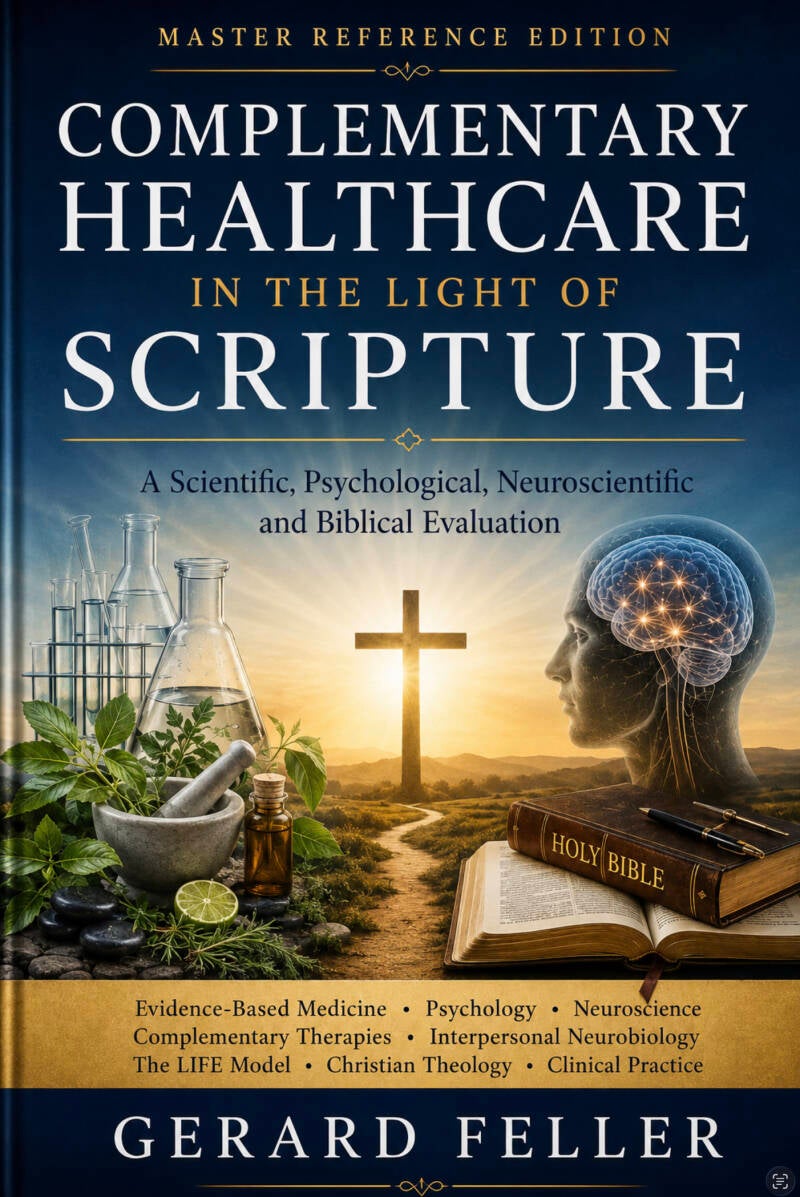
Complementary Healthcare in the Light of Scripture — Master Reference Edition by Gerard Feller is an extensive reference work exploring health, healing, and complementary healthcare from scientific and Christian perspectives. Across seventeen main chapters and six appendices, the author examines the relationship between medical knowledge, psychology, neuroscience, and biblical convictions. Its central question is how people can make responsible healthcare decisions while considering scientific evidence, safety, human dignity, and spiritual discernment.
The book begins with the understanding that health involves more than the absence of disease. Physical functioning, emotions, relationships, living conditions, meaning, and faith influence how people experience illness and recovery. Feller discusses several approaches to health, including the biomedical model, the biopsychosocial model, and whole-person care. He also addresses resilience, prevention, quality of life, and living with chronic conditions. Readers are encouraged to consider what good care means when complete recovery is not possible.
A substantial part of the book examines the historical development of complementary therapies. The author describes how healthcare practices emerged within different cultures, medical traditions, and worldviews. He then explores the points of contact between traditional care, modern medicine, and integrative approaches. A recurring distinction is that a treatment’s age, popularity, or natural origin does not, in itself, establish its effectiveness or safety. Historical significance, clinical outcomes, and underlying beliefs each require their own evaluation.
The discussion of specific therapies is extensive. Herbal medicine, vitamins, minerals, dietary supplements, orthomolecular medicine, acupuncture, and homeopathy receive considerable attention. In its examination of herbal products, the book discusses active constituents, pharmacological processes, product quality, and potential interactions with medicines. The chapters on supplements distinguish between correcting an identified deficiency and making broader promises about health, immunity, or performance. Research findings, possible adverse effects, and differences between patient populations are also considered.
Feller also examines breathing techniques, breathwork, and relaxation methods. These chapters explore the relationship between physical tension, stress responses, attention, and emotional regulation. The author discusses practical applications alongside the theoretical and sometimes spiritual explanations associated with these exercises. This connects with a question running throughout the book: how can the effects of a practice be distinguished from the worldview or spiritual meaning attributed to it?
The later chapters shift towards neuropsychology, human development, and trauma recovery. Topics such as memory, neuroplasticity, executive functioning, attachment, and emotional regulation are connected with questions about identity and human personhood. The book considers both the possibilities and limitations of explanations based on brain function. Neuroscientific insights are discussed alongside a biblical understanding of the human person as possessing physical, psychological, relational, and spiritual dimensions.
A major section examines the LIFE Model, which connects relationships, attachment, joy, emotional development, and Christian discipleship. Feller investigates how this model is used in counselling, pastoral care, and support for people affected by trauma. The nineteen Relational Brain Skills receive a separate, detailed discussion. He considers capacities related to connection, coping with distress, relational stability, and mature functioning, together with their possible significance for personal growth and community life.
The edition also includes a dedicated critical evaluation of the LIFE Model. This distinguishes research on individual concepts—such as attachment, emotional regulation, and resilience—from research evaluating the integrated model as a whole. Evidence supporting an individual component does not automatically validate the complete method, its classification of skills, or its proposed neurological explanations. This attention to theoretical coherence, independent testing, and scientific limitations gives the discussion an investigative character.
The Christian perspective provides the connecting thread between the different subjects. The book discusses health and healthcare in relation to creation, human dignity, brokenness, responsibility, redemption, and hope. Prayer, pastoral involvement, and Christian community are considered alongside professional care. At the same time, the edition emphasises the distinction between empirical research findings and theological interpretations. The biblical call to test everything and hold fast to what is good guides its evaluation of both therapies and explanatory models.
With more than 1,100 pages, this edition is primarily intended for sustained study and consultation. Its chapters include learning objectives, key concepts, tables, diagrams, practical examples, evidence summaries, reflective questions, and references. The appendices provide biblical principles for evaluation, an explanation of levels of scientific evidence, an overview of therapies, a Scripture index, and a historical timeline. An extensive atlas containing sixty schematic plates visually brings together subjects such as stress, recovery, development, interdisciplinary care, and healthy ageing.
The book is written for healthcare professionals, pastoral carers, counsellors, educators, students, and interested Christian readers. It presents itself as an educational reference work that encourages careful investigation, thoughtful questioning, and a clear distinction between different forms of knowledge. Its contribution lies in the broad connections it seeks to establish between healthcare, human functioning, and Christian faith, while attending to both practical care needs and the convictions that shape our choices.